How We Failed — and Finally Finished — the West Highland Way
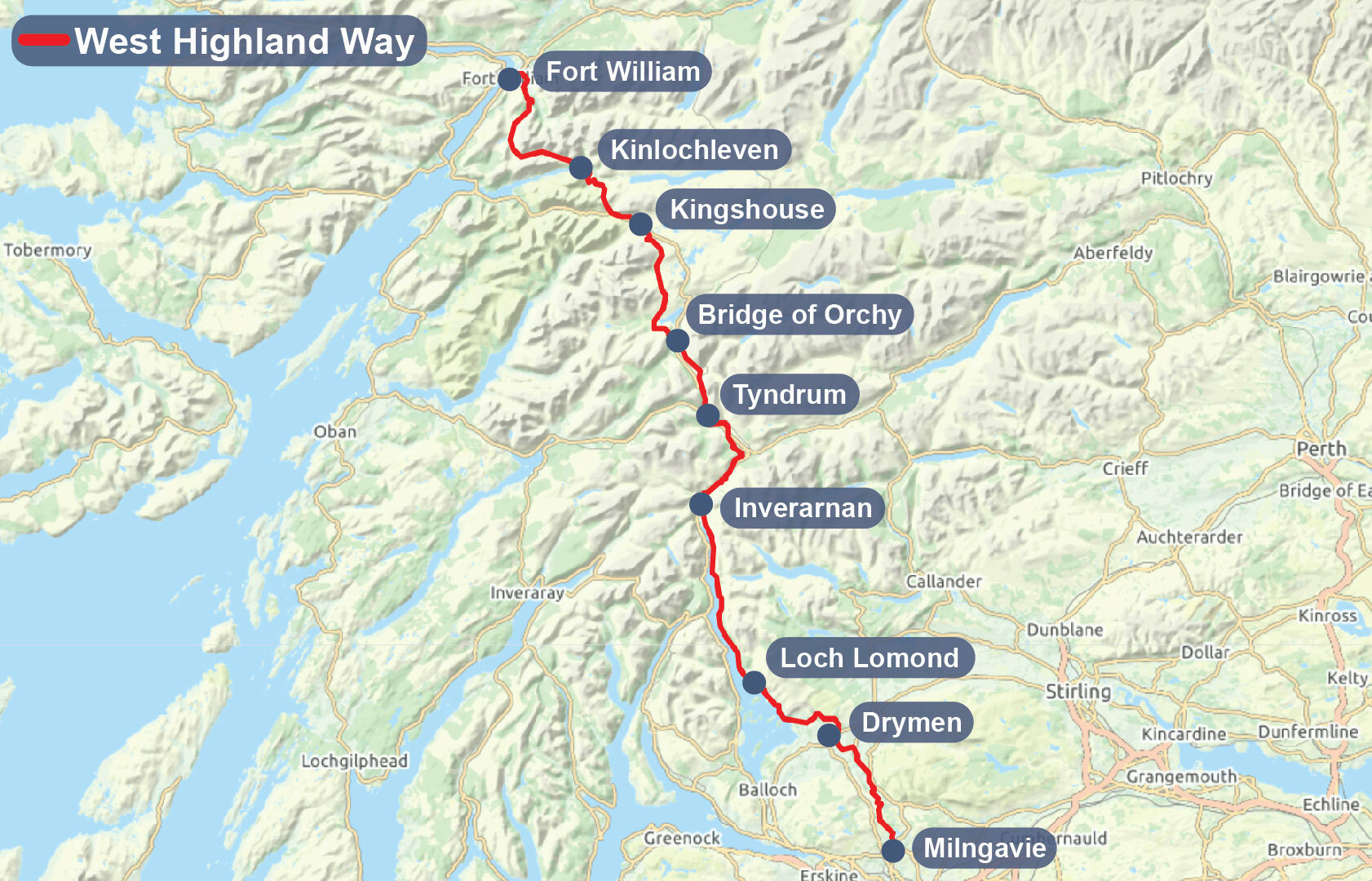
In September 2021, we flew to Glasgow in Scotland to embark upon the legendary West Highland Way trail for the first time. The 96 mile route running from Milngavie to Fort William in the Scottish Highlands is a popular multi-day hiking trail, with over 40,000 people from all over the globe taking up the challenge each year.
Unfortunately for us we didn’t manage to finish, and one week after our arrival we returned home having failed to complete the full 96 miles. It was frustrating and humbling — but also one of the best lessons we’ve had on the trail. In the following days and weeks we discussed our journey, analysed our video footage and the notes we’d made, in an attempt to determine why we’d failed!
In this article, we break down the seven main reasons hikers fail the West Highland Way. We share the mistakes we made and the things we got wrong, along with the practical steps we took to overcome them. Think of it as your shortcut to success — advice shaped by real miles, wet boots, and lessons learned the hard way.
Thankfully there is a happy ending, we returned the following year and successfully completed the trail, but I’m getting ahead of myself, more on that later…
A Trip 40 Years in the Making

So, a bit of background before we set off… We’re a couple in our late fifties who’ve spent more than four decades hiking and camping our way around Britain, happiest with boots on our feet and a map tucked in a side pocket. In all that time, we’ve wandered countless trails across England, Scotland, and Wales—yet, somehow, the West Highland Way had always eluded us, it never quite made the cut. Maybe it was the 1,200-mile round trip to get there and back, or perhaps I’d unfairly written it off as a little too touristy. Either way, it had sat on our list for years.
When Everything Changed
Then in 2019, Covid hit the UK and everything changed – our boots were hung up for the first time in decades. Like everyone else, we found ourselves indoors far too long—watching an embarrassing amount of YouTube (come on, you know you did too!). Somewhere in that blur of lockdown, I fell down a rabbit hole of long distance backpacking videos—most of them set in the vast wilderness of the US rather than the UK.
The Dream Begins
So when restrictions finally began to ease in early 2021, we started talking about doing something big again—a proper adventure further from home. Over the years I’d walked many of Britain’s great trails, so I began searching for something fresh to sink our boots into. The West Highland Way kept coming up, ticking all the boxes for distance, scenery, and challenge. After years of putting it off, it suddenly felt like the perfect time.
Planning and Preparation
Over the next six months we planned our trip and treated ourselves to some new gear –just because, okay – upgrading our “Big 4” items and opting for good-quality lightweight kit. We mapped out our itinerary, completed our training and finally in September 2021 we arrived in Scotland. So far, so good—or so we thought.
Setting Off from Milngavie
By the time we finally stood at the obelisk in Milngavie, it felt almost surreal. After months of talking, planning, and dreaming, we were actually here—rucksacks packed, boots laced, the promise of the Highlands stretching north before us.
The morning was warm and still, the sort of quiet that only comes before a long journey. A few other walkers milled about, taking the obligatory photo at the start sign, others getting snacks from Greggs, all of us sharing that same nervous excitement. Within minutes, the suburban paths gave way to woodland trails and open farmland, and the rhythm of walking with a fully loaded backpack returned like an old friend.
A Short-Lived Joy
There was something deeply satisfying about it—being back on the trail after so long, moving under our own steam again. With every step, the noise of the past year seemed to fade a little further behind us.
Sadly, that feeling didn’t last. By the time we reached Tyndrum, our West Highland Way journey was over. Words can’t quite capture the mix of disappointment and frustration that came with having to stop—I was utterly devastated.
Lessons Learned
Looking back now, it’s easy to see where things started to go wrong. Some issues were avoidable, others were simply bad luck—but together, they were enough to end our hike sooner than we’d hoped. If there’s any silver lining, it’s that we learned a lot from the experience.
So, in the spirit of honesty (and helping fellow hikers prepare a little better), here are the seven reasons we didn’t finish the West Highland Way. I share them in the hope that they’ll be useful, maybe even a little reassuring, and help you avoid making the same mistakes we did.
1 – INSUFFICIENT TRAINING
We started our training about 3 month prior to the trip, consisting mainly of day hikes, 3 or 4 times a week in our local area, which has terrain very similar to that of the West Highland Way. With climbs of around 400 metres (approx 1,300 ft) and distances of between 5-8 miles, we carried daypacks with around 7-8 kgs.
After several weeks we could complete the hikes with relative ease, and assumed we were in good shape. We were wrong!
👉 Reality Check: Our planned hiking itinerary for the West Highland Way was between 11 – 17 miles each day, and the weight we would carry was almost double what we trained with. With the benefit of hindsight, we now realise we were not walking far enough each day and our packs were simply too light.
💡 Our Tip : As your training progresses, start to increase the distance to at least the average you expect to travel each day. Secondly use the actual pack you’ll be taking on the trip and increase the weight to at least an approximation of what you’ll be carrying on the trail.
2 – PACK WEIGHT
From experience I was well aware of having too much weight in our packs on a multi-day hike. As usual, I meticulously weighed every item we were taking and calculated a base weight of around 9.5 kgs (excluding food and water). I used the online LigherPack app to keep track of our gear and we seemed to be in good shape…
Unfortunately, after almost 2 years of no hiking, we both fell into the “just one more item won’t hurt” trap. In the last few days leading up to our trip we added more and more SMALL items that would seemingly make little to no difference (Hmmm!). We also convinced ourselves that several items were essential or necessary when in fact we never used them at all.
👉 Reality Check: On returning home my pack weighed 14.5 kgs. Considering I normally carried 1.6L of water, this meant I was carrying 16.1 kgs on trail. For an overweight guy in his fifties that was simply too much to be sustainable over multiple days. Similarly my wife’s pack weighed in at 12.5 kgs including water. Now she is a lot fitter than I am and she never once complained, but 12.5 kgs on a 52 kg girl (24% of her body weight) was too much, even for someone far younger.
The biggest weight contributors were…
- Spare Clothing (not including essentials like wet weather gear and underwear/socks) – Me 1.4 kg | Her 1.1 kg
- Excess Food – I carried approx 600g of food we did not eat from day 1.
- Camera Gear – 700g of unused gear I though I couldn’t do without.
- Flight Bags for our Backpacks that we had no place to store, so had to carry. – 590g each
- Additional Electrical Items such as chargers and an extra power bank – 450g not used
- Spare Phone – Despite us both having our phones, I though it prudent to carry a spare just incase, WTF! – 180g
- Large First Aid Kit – Ours weighed 420g, it should have weighed 200-250g at most
- WHW Guide Book – Read over and over before the trip. Didn’t read once on trail – 250g
- Sit Mats – We never used them as we used a full length sleep pad for sitting and cooking on – 200g
All of that added up to a whopping 4.6 kgs for me and over 1.8 kgs for her.
💡 Our Tip: Don’t Get Carried Away
It’s incredibly easy to keep adding “just one more thing” to your pack. Start by making a realistic assessment of your ideal pack weight. Then lay out everything you plan to take — including all those tempting extras — and weigh it. I can almost guarantee it’ll be heavier than you expected.
Now go through each item methodically and remove anything non-essential or rarely used. Be ruthless. Ask yourself, “Will I actually use this?” If the honest answer is no, or even maybe, leave it behind.
Once you’ve reached your target weight and you’re happy with your setup — leave it alone. Resist the urge to sneak in those last-minute additions before you set off for Milngavie. Your shoulders (and morale) will thank you later.
3 – EATING ENOUGH CALORIES
Walking 10 to 15 miles a day requires considerably more calories and energy than normal. Unfortunately we did not plan our meals well and often substituted snacks for proper meals or missed meals completely.
This was not really apparent until day 3 when our energy levels seemed to be dropping earlier in the day and we both felt more lethargic as time went on.
It is very easy to overlook eating good calorie rich meals whilst thinking about getting to that next location. Oftentimes we convinced ourselves there were no suitable spots to take a break and have a bite to eat. It was far easier to simply eat a protein bar or some chocolate “on the go”.
In hindsight: We should have planned our food better and chosen better high calorie trail meals for the trip.
💡 Our Tip: Plan your meal breaks and carry sufficient high calorie food to provide the extra sustenance. Also plan possible locations to eat, such as Cafe’s and Restaurants along the route and finally — make time to actually stop and eat.
4 – PHYSICAL HEALTH
Was our age and physical condition a factor in us failing to complete the West Highland Way. In and of itself I would have to say no.
Indirectly, when considered together with other factors, such as the ability to sustain a rapid pace over rugged terrain with an overweight backpack, and insufficient energy from not eating – then yes.
I knew we were going to be slower and cover less ground than many others on the trail, but initially I wasn’t mentally prepared for this.
As many hikers passed us during the day it was completely disheartening and demotivating. Admittedly they were mostly much younger than us or were ‘section’ hikers with daypacks, but we still assumed (wrongly), that we were somehow falling behind or not keeping pace and this encouraged us to over-exert ourselves.
👉 Our Tip: Hike Your Own Hike!!! Ignore what others are doing, set your own pace and simply enjoy it.
5 – MENTAL HEALTH
We both suffer with mental health and we have always been open and honest about our conditions. However hiking has always been an enjoyable experience for us, one that contributes positively to our overall mental wellbeing. Unfortunately for us the West Highland Way changed all that somewhat.
At the start of our journey, every uphill section or obstacle on the trail was greeted with determination and enjoyment. Mentally shrugged off as being exactly what was to be expected, simply part of the experience!
As the days progresses however, I became more and more despondent and every twist on the trail seemed to lead to yet another unseen uphill section, each with several false summits. I began to dread these moments and at times walked in complete misery.
Whilst I cannot stress enough how mentally challenging the West Highland Way can be, looking back I realised these episodes were brought on by factors within my control.
They were always towards the end of the day and there was a direct correlation between my declining mental state and my declining physical condition, brought on by my overweight pack and lack of food.
👉 Our Tip: Try to be aware of, and limit the contributing factors that may be effecting your overall positivity. Easier said than done, I know!
6 – GEAR FAILURE
For navigation we had the excellent Harvey Map of West Highland Way, the West Highland Way Guidebook with OS Maps and the Maps.Me ‘offline’ mapping app on my iPhone. Whilst we used the Harvey map each night at camp, out on the trail it was much easier to whip out my phone and check our location and progress than consulting the other two. I know, I know!
Unfortunately this reliance on technology (which I normally never do), and it’s failure later on, had a considerable impact on MY decision to head home. On the day we headed for Tyndrum the app map showed we were much closer to Tyndrum than we actually were. However at the time I was sure we had walked close to that distance and assumed we were within about half a mile of Tyndrum as the app indicated.
Both of us were by now suffering from the effect of overweight packs, blisters and a gnawing toothache that I had developed the previous day. But with only half a mile left, we decided to press on and sort ourselves out at Tyndrum.
When I checked the Harvey Map some twenty minutes later having seen no signs of civilisation, I realised we were about another 2.5 miles from Tyndrum, which would take at least another hour or so.
The Final Straw
It was at this point I became very disheartened and depression started to set in. I’m not ashamed to say, I sat down on the trail and shed a tear or two. My mental capacity for more uphill sections and further failures overflowed and I decided there and then, enough was enough… it was time to go home.
A little while earlier in the afternoon my wife had spoken to our daughter and hinted at our flagging physical condition and my depression and she chose that moment to ring and tell us she had booked us into the Tyndrum Inn for the night where we could get a good nights sleep and a bath to help with our aches and pains.
So reluctantly after a short break we plodded slowly on until we reached Tyndrum. Where we did get a hot shower, a great meal in the Good Food Cafe and a decent nights sleep on a soft mattress.
👉 Reality Check: The annoying part of this scenario was that I had the tools to do the job better, but instead of alternating between the App and Map as I normally would… I choose convenience over efficiency.
💡 Our Tip: Don’t rely solely on one method of navigation, and if you’re unsure use an alternative to check.
7 – MEDICAL EMERGENCY
At the Tyndrum Inn we had agreed to sleep on the things and leave the decision to continue or not until after breakfast in the morning. Unfortunately when I awoke the following morning the left side of my face was swollen and I had an excruciating pain in my jaw where I had previously had toothache. I realised this was something more urgent than a loose tooth.
On the day after returning home I was admitted to hospital and underwent an emergency procedure to drain an abscess in my jaw and also to remove a large molar. There would have been no way of continuing the trail with this medical condition and I was fortunate to be home as my condition became worse.
👉 Our Tip: Accept that sometimes, going home is the RIGHT Choice.
Final Thoughts and Conclusion
Having come home and assessed our journey, we were able to pinpoint how things went wrong for us. In truth there was not one single problem that caused us to abandon our journey, although some weighed more heavily than others, the failure was simply an unfortunate culmination of several factors occurring together.
Make no mistake the West Highland Way is both Physically and Mentally challenging and as you stand on the brink of this adventure, remember this: you already have the advantage of our mistakes — worn boots, off-kilter plans, and lessons learned the hard way.
The West Highland Way can push you physically, test you mentally, and surprise you in ways you didn’t expect — but it can also reward you in ways you’ll carry for life. So lace up your boots, take a breath, and let Scotland’s hills welcome you. The path is ready — go claim your own story 🌿 🥾⛺️
⭐️ Update: With the insights we’ve shared here, we returned to successfully completed the West Highland Way in August 2022, and again with our Granddaughter in 2024 … and we’re already planning to go back in 2026.


⛰️ Ready to Take on the West Highland Way?
Before you set off, check out my complete West Highland Way Guide — packed with everything you need to plan the trip properly: when to go, what to pack, full 5–11 day itineraries, wild camping tips, accommodation, maps, transport and real lessons learned on the trail.